> ## Documentation Index
> Fetch the complete documentation index at: https://quintsecurity.mintlify.site/llms.txt
> Use this file to discover all available pages before exploring further.
# System Architecture
> Three-tier architecture: ES extension (truth), forward proxy (intent), and the cloud platform. Covers session detection, event ingestion, and the API service.
# System Architecture
Quint is a three-tier security platform that combines OS-level ground truth (EndpointSecurity system extension), intent-level interception (forward proxy plus MCP gateway), and a cloud platform for fleet-wide visibility. The key security signal is **divergence** between what an agent claims to do and what actually happens on disk.
## Target-state architecture
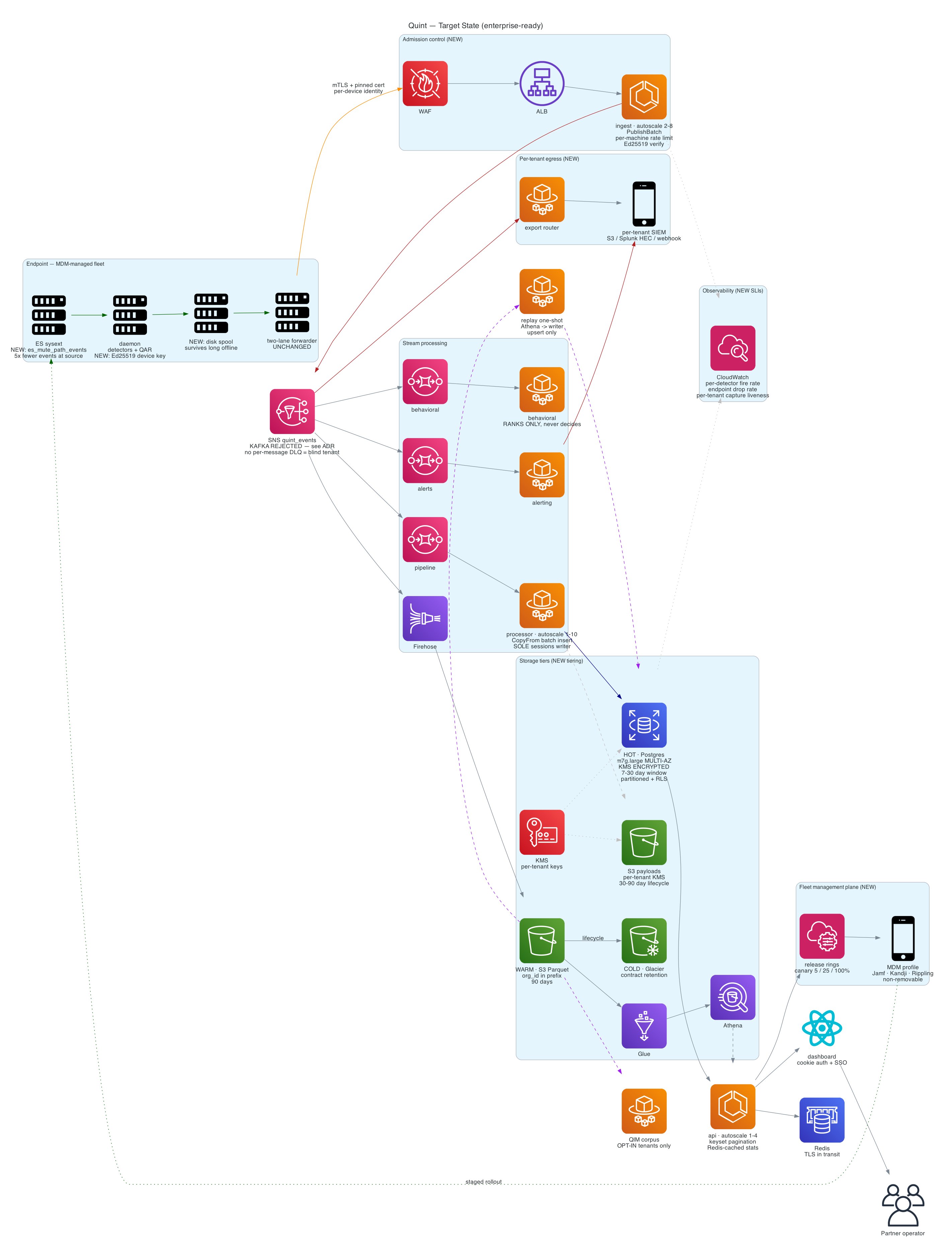
The diagram below is Quint's **enterprise-ready target state** — the north-star topology the platform is converging on. Events flow from an MDM-managed endpoint fleet over the SNS/SQS bus into stream processing and tiered hot/warm/cold storage, with per-tenant egress to customer SIEMs and a dedicated fleet-management plane. Note that the behavioral stream **ranks only and never makes an enforcement decision**. The tiers described in the rest of this page are the **current shipping implementation** this target state builds on.
 ## Three-Tier Architecture
```mermaid theme={null}
flowchart TD
subgraph T1["Tier 1: Edge (macOS pkg)"]
ES["EndpointSecurity Extension (Swift)
## Three-Tier Architecture
```mermaid theme={null}
flowchart TD
subgraph T1["Tier 1: Edge (macOS pkg)"]
ES["EndpointSecurity Extension (Swift)
9 event types, code-signing detection"]
NE["Network Extension (Swift)
Transparent LLM API interception"]
Daemon["Go Daemon
LaunchDaemon service"]
FwdProxy["HTTPS Forward Proxy
MITM TLS, 7 LLM parsers"]
MCPGateway["MCP Gateway and Stdio Relay"]
UniSession["Unified Session Tracker
process scanner, PID reaper"]
Forwarder["Cloud Forwarder
batch 500, 1s flush, overflow-to-disk"]
ES -->|Unix socket + auth| Daemon
NE -->|Unix socket :9091| Daemon
FwdProxy --> Daemon
MCPGateway --> Daemon
Daemon --> UniSession
Daemon --> Forwarder
end
subgraph T2["Tier 2: Cloud Platform (AWS ECS)"]
Ingest["Ingest Service
/v1/ingest, deploy-token auth"]
SNS["SNS FIFO + SQS fan-out"]
Pipeline["Pipeline Service
Postgres writer, monthly partitions"]
SessionProc["Session Processor
upserts sessions table"]
AlertProc["Alert Processor
rule evaluation"]
API["API Service
REST + SSE"]
PG[("PostgreSQL
RLS, monthly partitions")]
Redis[("Redis
token cache, SSE pubsub")]
Forwarder -->|HTTPS batch| Ingest
Ingest --> SNS
SNS --> Pipeline
SNS --> SessionProc
SNS --> AlertProc
Pipeline --> PG
SessionProc --> PG
AlertProc --> PG
API --> PG
API --> Redis
end
subgraph T3["Tier 3: Dashboard (Vercel)"]
Dashboard["Next.js app
session-centric views"]
API --> Dashboard
end
style T1 fill:#1a1a2e,stroke:#FF3C22,stroke-width:2px
style T2 fill:#1a1a2e,stroke:#58a6ff,stroke-width:2px
style T3 fill:#1a1a2e,stroke:#a371f7,stroke-width:2px
```
### Tier 1: Edge
Runs on the user's machine as a signed `.pkg` install.
* **QuintAgent.app** hosts two system extensions:
* [Endpoint Security](/edge/endpoint-security) for kernel-level process and file events
* [Network Extension](/edge/network-extension) for transparent LLM API interception
* **Go daemon** runs as a LaunchDaemon. It operates the [forward proxy](/edge/forward-proxy) (MITM TLS plus MCP relay/gateway), the [unified session tracker](/edge/daemon), and the cloud forwarder. Events stream to `api.quintai.dev` via HTTPS.
* **Audit log** at `~/.quint/quint.db` with Ed25519 signatures and SHA-256 hash chaining. Every captured request, response, and tool call is attributable to a specific session.
### Tier 2: Cloud Platform
Deployed on AWS ECS Fargate. Five services share one Postgres instance and one Redis cache:
| Service | Role |
| ----------------- | -------------------------------------- |
| ingest | Authenticate, validate, fan out to SNS |
| pipeline | Consume SQS, write `actions` table |
| session-processor | Upsert `sessions` table |
| alert-processor | Evaluate rules, write `alerts` |
| api | Dashboard and public API |
Row-level security is enabled on all tenant tables using `app.current_org_id`. The `actions` table is partitioned by month. See [Cloud Overview](/cloud/overview) for the full model.
### Tier 3: Dashboard
Next.js on Vercel. Reads from the API service over Supabase JWT or API key. Session-centric views with drill-down into each action. See [Dashboard Architecture](/dashboard/architecture).
## Signal: Intent vs. Truth
The proxy sees what the agent **claims** to do. The ES extension sees what the OS **actually** does. Divergence is the high-confidence signal.
Example: an agent that says "read `config.json`" but actually opens `~/.ssh/id_rsa`. Tier 1 captures the tool call. Tier 2 captures the file open. The mismatch triggers an alert.
## End-to-End Flow
See [How It Works](/concepts/how-it-works) for a single tool call traced through all layers.
## Deployment Topology
### Production (AWS)
| Service | Resources | Purpose |
| ----------------- | --------------------- | -------------------------------------- |
| API Service | ECS Fargate | REST API, event ingest |
| Ingest | ECS Fargate | Token auth, validation, fan-out |
| Pipeline | ECS Fargate | SQS consumer, Postgres writer |
| Session Processor | ECS Fargate | Session lifecycle upserts |
| Alert Processor | ECS Fargate | Rule evaluation |
| PostgreSQL | RDS t4g.medium | Events, sessions, partitioned by month |
| Redis | ElastiCache t4g.micro | L1 cache, rate limiting, SSE pubsub |
| ALB | Elastic Load Balancer | HTTPS termination with ACM certificate |
Infrastructure is fully Terraformed under `quint-platform/infra/terraform/environments/prod/`.
### Endpoint (macOS)
| Component | Footprint | Purpose |
| -------------- | ------------------ | ---------------------------------- |
| QuintAgent.app | \~20MB disk | Container for system extensions |
| ES Extension | \~50MB RAM steady | OS-level event capture |
| NE Extension | \~40MB RAM steady | Transparent network interception |
| Go Daemon | \~100MB RAM steady | Proxy, session tracking, forwarder |
| Local SQLite | 10-100MB | Signed audit log (rolling) |
## Security Properties
Source code content, credentials, and full LLM conversation bodies never leave the machine. Only structured metadata (tool name, capability, risk decomposition) goes to the cloud.
* **Audit log tampering:** Ed25519 signature per row, chained by `prev_hash`. A single modification breaks the chain.
* **TLS MITM:** per-hostname leaf certs signed by a local CA that never leaves the machine.
* **Cloud auth:** deploy tokens are SHA-256 hashed in Redis, JWT for dashboard users.
* **Tenant isolation:** Postgres RLS on every tenant table, SNS/SQS FIFO ordering per session.
## Design Principles
1. **Local-first capture, cloud-first scoring.** Raw bodies stay on the machine. Normalized events flow to the cloud.
2. **Lossy at the edge, durable in the cloud.** Under backpressure, the edge drops events rather than block user traffic. The cloud retries.
3. **Zero client changes where possible.** Forward proxy plus NE means no SDK integration, no new endpoints.
4. **Session-centric model.** Everything anchors to sessions, not raw events. Audit rows, cloud events, and dashboard views all join on `session_id`.
5. **Code signing first.** Agent detection uses macOS code signing as the highest-confidence signal, falling back to process name and path matching only when signing data is unavailable.
6. **Tenant isolation at every layer.** Deploy tokens are scoped to organizations. Postgres uses monthly partitions with row-level security. Cloud queues use FIFO ordering keyed by session.